Playful Pathways
Service Design for Educational Care
Enhancing Communication in Educational Care Through Playful Engagement
Client
CrossReach, Erskine Waterfront Campus
Role
Project coordinator
Design researcher
Workshop facilitator
Product creator
Design team
Shaoxiong Guo
Dharmishta S. Naidu
Abby Milliken
Sijin Li
Xianrui Fu
Where
Glasgow, UK
Duration
02.2024-04.2024 (3 months)

Overview
Playful Pathways aims to enhance communication in educational care through interactive engagement, focusing on how past pupils can support current pupils in the care system via play elements. It looks at building relationships within the care education system in Scotland. The developed Mentorship Programme looks at how the lived experience of past pupils can help to improve the experience for current pupils with safe-gaurders as facilitators.
1. Final Outcome
We designed Playful Pathways Mentorship Programme—a structured service that brings past pupils back into the educational care system as trained mentors, helping children rebuild trust, develop emotional resilience, and learn practical life skills through playful engagement.

Key Deliverables
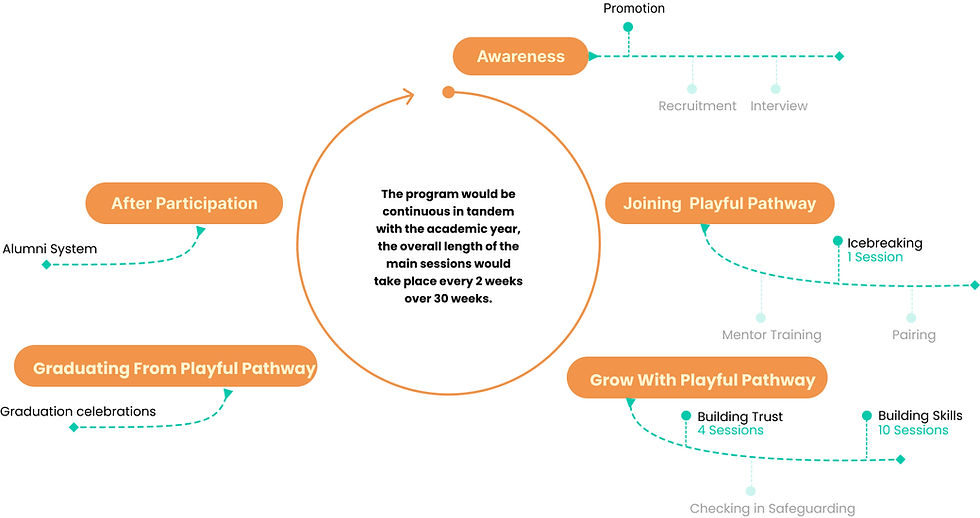
① A 15-session Mentorship Journey
Supported by staff as gatekeepers, featuring:
-
Group ice-breaking
-
One-on-one mentorship
-
Skill-building activities
-
A final celebration & graduation
② A complete Activity Card Kit
To guide safe, consistent interactions:
-
Icebreaking Cards ×10
-
Building-Trust Cards ×13
-
Building-Skills Cards ×20
-
Celebration Cards ×7
-
Stop Card
-
Blank Card
The colour-coded system ensures children progress emotionally at their own pace.
LEGO
Challenge
Let the pupils use LEGOs to try and recreate some of their favourite things. This could be anything from their favourite place, food, object or hobby. They can be as creative as they like and then see if they want to have people guess what they’ve made.
30 mins


X People

For the 1st Session
10 Icebreaking Cards
Fishing
Have a try at at growing your fishing skills with a casual outdoor session where everybody can pick up some tips and tricks from people and hopefully get a snap with whatever they catch.
All Day
X People
For the 2nd - 5th Sessions
13 Building Trust Cards
Three Legged Race
The pairs must stand next to each other, tieing one of their legs to their partners to create 3 'legs' between the pair. On go, the pairs race to see who can end up at the ending point first.
10 mins
x Ppl
For the 6th - 14th Sessions
20 Building Skills Cards
Fieldtrips
1- 7 Days
X People
Grab your backpack and get ready! Whether you're deciphering ancient artifacts, analyzing ecosystems, or navigating cultural interactions, each field trip offers a unique opportunity to develop practical skills that extend beyond the classroom
For the 15th Session
7 Celebration Cards

The card front is distinguished by four colors, indicating different sessions.
I’d like to leave.

‘Stop’ Card for pupils to participate at their own pace
Blank Card
?
Open to suggestions from pupils,
use your creativity!
? mins
X People
Open Suggestion Card for new activity Ideas
Mapping how past pupils, pupils, and staff interact through recruitment, training, matching, activities, safeguarding, and reflection.
③ Service Blueprint & Stakeholder Journey

2. Impact
-
Children became more willing to express emotions during playful, low-pressure activities.
-
Past pupils learned a safe and structured way to re-enter the care system as positive role models.
-
Staff reported that the system reduced behavioural resistance and strengthened trust.
-
The programme creates a sustainable circle of care—today’s pupils can eventually return as mentors.
3. Why This Matters
The Scottish care system struggles with:
-
Distrust between children and adults
-
Trauma-related behavioural barriers
-
Communication issues caused by safeguarding language
-
A lack of relatable role models
Past pupils’ lived experience makes them uniquely positioned to support current pupils—but no current system safely integrates them. Playful Pathways fills that gap by creating a trauma-informed, structured, emotionally safe service.


Metaphor: children are shifted again and again through lies and jargon, as if they were walking a ladder between mountain tops. Ideally, communication should be like water, so that children feel free and soft.
4. How We Got Here
Step 1 — Understanding the Emotional Landscape
We conducted multi-stakeholder research:
Children(Core user)
Through a story-based workshop (“Leaving Earth for a new planet”), they revealed:
-
What support they wish they had
-
What worries them
-
What qualities they want in a mentor
-
How they prefer strangers to approach them
Past Pupils
Interviews showed:
-
They deeply empathise with current pupils
-
They want to return and “give back”
-
They need training to avoid unintentionally triggering trauma
-
Practical life-skills transmission is valuable & desired
School Staff
Ethnographic visits explored:
-
Daily routines and emotional rhythms
-
Existing communication gaps
-
Safeguarding responsibilities
-
Physical and social environment constraints
External Social Workers
Validated:
-
The role of past pupils aligns with The Promise and GIRFEC
-
But must be carefully regulated, especially around boundaries and emotional load


Step 2 — Insight Synthesis
We mapped:
-
Emotional journey of children in care
-
Stakeholder relationships
-
Points where past pupils can safely intervene
See the big picture:
-
Relationship-building must be slow and consistent.
-
Communication must feel “like water” — gentle, jargon-free, non-threatening.
-
Play supports emotional expression better than direct questioning.
-
Gatekeepers (staff) must remain present at all times for safety.
These insights shaped the structure of the mentorship journey.


Step 3 — Designing the Service
We translated insights into actionable structures:
Training System
Clear do/don’t rules to protect children's emotional and physical wellbeing.
Phased Interaction Model
-
Start with low-pressure activities
-
Slowly introduce trust-building tasks
-
Transition into skill-development
-
End with celebration & continued connection
Matching Strategy
Children meet several past pupils in group activities and choose the mentor they connect with most.
Playful Tools
The card kit ensures emotional safety and empowers children with control.

5. My Role
-
Led research planning & participant engagement
-
Conducted interviews with children (via workshops), staff, past pupils, and social workers
-
Synthesised insights into frameworks, maps, and blueprints
-
Co-led service co-creation
-
Designed the mentorship system and activity card toolkit
-
Coordinated team workflow and facilitated workshops